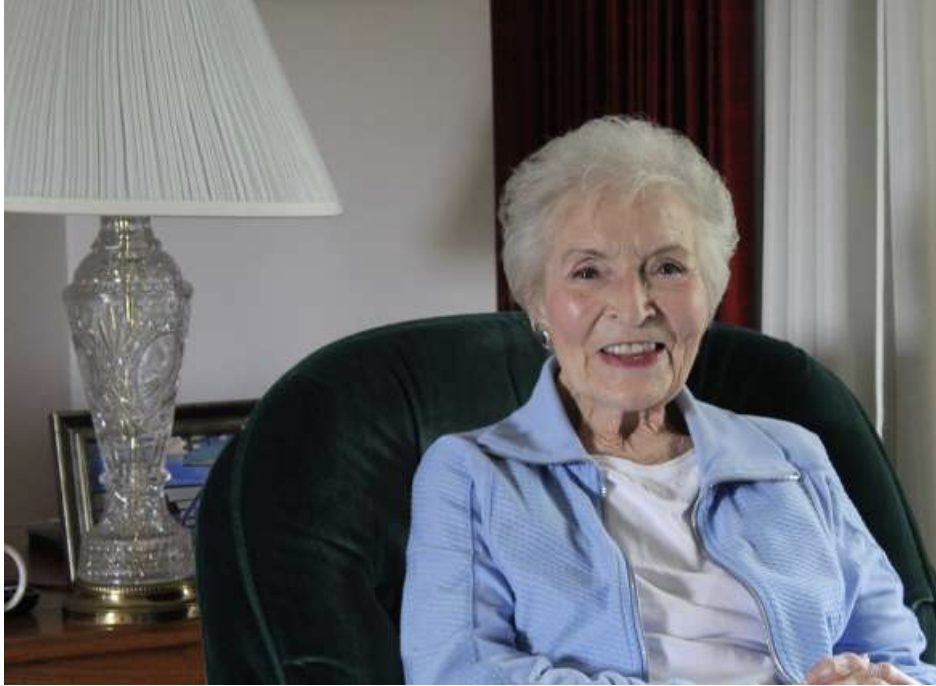
Recently, I visited with Harlene Hill. I knew we would have a lot to talk about.
We first met at the Belle Fourche Rec Center pool a few years ago. Harlene loves to frequent the pool. “It’s one of the reasons I live here.” She told me.
Harlene grew up on a ranch. Her uncle M.C. Sharpe was the governor of South Dakota. She has travelled extensively in Europe. She has walked on The Great Wall of China. And in her 50s she followed through on an interest in skydiving.
Harlene also plays the piano, but not so much now with the arthritis that has creeped into her fingers.
She described her exhilarating skydiving experience. “The big jolt is when the chute opens. That was harder than the landing.” She explained, “There was someone who stays with you during the jump and tells you when to pull the cord.”
Harlene has not been skydiving since, nor does she want to remarry. “I’ve been a widow for ten years. Every silly decision is yours. Should I drive today or not? It’s OK to be in charge.” She said with composure.
For most of her adult life, Harlene has resided in Belle Fourche. She and her husband, Leroy Hill raised their four children here. After 28 years of teaching elementary school children, Harlene retired in 2022. She continues to serve as a dedicated volunteer at South Park Elementary School.
Last spring The Belle Fourche Education Association presented Harlene with the honorary annual accolade, Friends of Education Award. The award is presented to an outstanding supporter of education in Belle Fourche.
Harlene has witnessed some profound changes in Education. One memory is especially memorable as it illustrates how quickly technology has integrated schools.
As a teacher Harlene recalled having to remove the piano in her kindergarten classroom to make room for an Apple IIe computer bank. The Apple IIe is an early personal computer made by Apple, released in January, 1983. The ‘e’ in the name stands for ‘enhanced’. In with the new, out with the old and in this case the piano. Harlene adapted to the changes, but not without some sense of loss.
Harlene’s home is spacious, but modest and uncluttered. “Everything I have here means something.” She commented. And indeed, everything in Harlene’s home is symbolic of what is meaningful to her. Each item, and every furnishing represents respect for friendships, family, community, changing times, and public service. These were among the recurring themes in our conversation.
Respectability leads to stability. Harlene has some ideas about how respectability and stability are necessary components in education. She offered an analogy to the three-legged stool as a traditional symbol to explain what makes education as an institution thrive.
One leg of the stool represents the church, another home, and the third is a community’s school. The larger institution of education must rely on all three legs to be fully functional.
As a teacher, Harlene has respect for the teaching profession as well as the three “legs” that come together to make effective schooling possible. Harlene was a member and President of the local BF Education Association. She continues to be an advocate for the teaching profession, but doesn’t always agree with the present national organization.
“This is not the best of times.” She mused thoughtfully. “Rules and good manners have become so confused. I grew up in easier times”
Harlene Sharpe was the oldest daughter in a family of six. She attended school in Oacoma through the 8th grade, near the family ranch.
Harlene attended high school ‘east river’ in nearby Chamberlain. She earned top grades and learned quickly. She described herself as a “fairly good student” in high school although was “perhaps unchallenged” at times in most subjects. However, chemistry and math were more demanding disciplines for her.
As a high school student, Harlene had a job. She was a window dresser at the J.C. Penneys store in Chamberlain. Window dressers arrange displays of goods in shop windows or within a shop itself. Working is a store such as Penneys was coveted work especially for a teenager. One perquisite of the job was a 20% discount on clothes, a significant benefit to a high school student in Harlene’s time. “We took good care of our clothes in those days.” She commented.
*We checked in merchandise. There were big boxes to be unpacked.” Harlene recalls that all purchases had to be wrapped in paper. Plastic shopping bags were not in use in those days.
J.C. Penneys stores had a reputation for offering department store shopping to customers in rural communities throughout the mid 1900s. Many small towns boasted a main street J.C. Penneys store. The stores were almost always the same, recognizable by the yellow and black tile façade.
By today’s standards, the storefronts were narrow, but the interiors were laid out for easy shopping. An interior walkway down the center divided the departments and provided easy access to departments in the back of the store. Goods in each department were well organized and attractively displayed.
Hardwood floors, high tin stamped ceilings provided an appealing setting for shoppers. In many early J. C. Penney stores a rear balcony, was visible upon entering the store.
The description of the balcony led Harlene to describe another curious, but often forgotten feature of the early department stores. J.C. Penney handled transactions on a cash only basis. Money was not stored or collected on the sales s floor.
Rather, when a customer paid for a purchase, a cashier would take the customer’s money, place it in a closed container with a bill of sale, then send it via a wire “zip line” to the balcony by pulling on a rope. In the balcony, another cashier would return the change with a receipt, but the cash would always be kept in the balcony.
While Harlene was in high school the water in Lake Francis Case began to rise and there was need for a new bridge to Chamberlain and Oacoma across the Missouri River. The rising water was the result of hydro-electric dams being built all along the river making new bridges necessary. (https://moenvironment.org/blog/missouri-riv-er-dams)
While the new bridge was under construction, a temporary pontoon bridge was built so cars and pedestrians could travel back and forth.
A pontoon bridge is a ‘floating bridge’ with floats that support a road deck for pedestrian and vehicle travel. The buoyancy of the supports limits the maximum load that they can carry. Whenever a car drove over this remarkable bridge, the road would bend with the water. Harlene recalls that her younger sister was afraid each time they drove across the Pontoon bridge. According to a social media account of driving on a pontoon bridge, “The ripples caused by the passing cars are amazing. It’s like surfing on water and it’s an exhilarating experience that you’ll never forget.” (https://www.instagram.com/ gokhanoutdoors/)
Harlene’s seventy-year best friend is Sandra Addie. Harlene and Sandra have been friends since they met as freshmen at Black Hills Teachers College. “Everyone should have a seventy-year best friend.” Harlene said of her life-long friendship with Sandra. Perhaps these were more idyllic times. Harlene and Sandra have been friends ever since.
Many aspects of life for Harlene may have been determined by a set of societal rules, that are not the same today. Perhaps these were more idyllic times. However, Harlene asserts that life has never been easy then or now. Sadly, Harlene’s mother passed away in her forties. Harlene, the eldest daughter in the family was in her 20s, but this was a hard time for her father who was left alone with children and a ranch.
Drawn to the Black Hills, Harlene transitioned to Spearfish to attend Black Hills Teaching College. In addition to Sandra, Harlene met Leroy Hill while participating in the debate club. Leroy was a Korean War veteran, from Newell working on undergraduate degrees in business administration and economics.
Harlene and Leroy were soon married. They moved to Vermillion when Leroy attended law school and Harlene worked in an office at the university.
For a time, Leroy practiced law in Lyman County with Harlene’s uncle and former South Dakota State Governor, M.Q. Sharpe. Sharpe served as governor of South Dakota from 1943-1947. M.Q. Sharpe, along with many others, encouraged Leroy to run for public office. “It was a more mellow time.” Harlene said with reflection. Leroy was elected States Attorney of Lyman County in 1959 and practiced law in Kennebec until Governor Sharpe’s death in 1961. “He had a rewarding career and learned a lot as States Attorney.” Harlene noted.
Following M.Q. Sharpe’s death, LeRoy and Harlene and their small children made their way to Belle Fourche in 1962. LeRoy passed away in 2015, leaving behind a legacy of community service and compassion for others.
Harlene finished her undergraduate degree later as a non-traditional student. She began teaching. Along the way she earned a Master of Teaching degree.
Harlene who has always liked to read, discuss books, and travel continues to live a full life with many friends and interests.
Harlene is a member of the Inquiry Club, a long-time Belle Fourche book club. In the early days, Inquiry Club had 10-12 original members. At that time, the members bought a book at the beginning of the year. Throughout the course of the year the books were exchanged with other members. “It was a great system.” Harlene noted.
None of the original members are still alive, but today, the Inquiry Club continues to meet as a book club. The members also local writers and are always present at local public literary presentations.
Harlene still has a landline. However, she is more likely to use her cell phone when participating in weekly group chats with her four children. “We Zoom on weekends, all five of us. We keep up with one another. Our schedule varies, but we often plan our conversations for Sundays.”
Harlene’s four children live distantly but are very much a part of her daily life via telephone internet. All are educated professionals “with busy schedules” Harlene added.
Additionally, Zoom conversations with her three remaining siblings take place on a predictable weekly schedule, although two brothers have passed.
Harlene often reflects on history. “We were making progress as a country,” she said referring to civil rights. “We elected a black president and thought we could all relax. These days, almost every family has a brown faced member of the family. I think we’re healing from racism, but we really need to keep an open mind.”
She explained her philosophy of teaching concisely. “You have to love the kids.”
Read the full issue of the Belle Fourche Beacon by clicking here.