Roots #70
Mick Harrison is a Belle Fourche painter who is quite acclaimed in the professional art world.
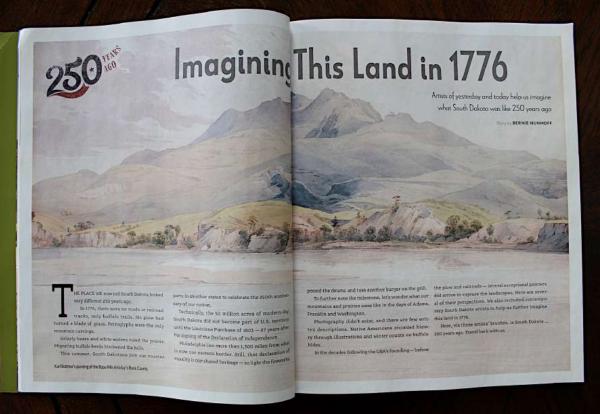
This summer he received some notoriety closer to home. The July August issue of South Dakota Magazine features the work of several regional artists who were asked to submit paintings of what South Dakota may have looked like 250 years ago.
Mick submitted a painting of a grizzly bear flushing a grouse. “There Were Grizzlies” is an oil on linen, 16” x 20”. “It took about two weeks to finish the painting, drying time included.” Mick told me.
The painting is another fine example of what I love about Mick’s work, vibrant colors, prairie landscapes, magnificent skies and settings that provoke a desire to crawl into the painting and stay for a while. (Perhaps without the Grizzly)
Mick explained how the South Dakota Magazine project came about. “They gave us a list of possible subject matter but gave us free reign on our own ideas.” He said.
“I originally picked a grizzly running from fire, but another artist had already picked that. I decided to use a background I had painted before of an area near where I grew up. No photos were used other than the background which was from a photo I took years ago. Even then, I used my ‘artist’s license’ in painting it.”
As I explained, Mick Harrison is a nationally recognized American artist who happens to live in Belle Fourche and a native South Dakotan.
He grew up in Mobridge in the 50s and 60s with a gift for drawing and an eye for cool cars, so he wanted to be a car designer. Unfortunately, Mobridge High School did not offer art classes.
However, Mick’s innate talent, eye for color, style and form earned his acceptance at the prestigious Los Angeles School of Art and Design, to pursue his dream. But the school was expensive. Mick opted for The School of Mines instead, but engineering school was not a good fit either, so he joined the U.S. Army.
Following a three-year tour of duty in the service Mick landed a job in in Cedar Rapids, Iowa as a staff artist for Rockwell International. With no formal art training, Mick apparently fell into the job. The work paid well. Life was secure and good, but Mick had made up his mind to be a fine artist. He resigned from the job and moved with his family back to Mobridge.
That was in 1974, nearly 50 years ago. Mick recalled how he and his wife Noreen celebrated with a dance when True West Magazine bought his first work. They have never looked back.
These days what Mick likes to do best is paint. His studio looks out over the bluffs east of Belle Fourche. The scenery reminds him of the prairie near Mobridge and the land west of the river where he spent summers at his grandparents’ ranch.
Mick describes himself as a prairie painter. Primarily Mick paints in oil on large canvases. He is prolific painter with an impressive portfolio.
In Mick’s work, colors are magnificent, skies are vast, even grass and the occasional tree take on meaning. People populate the landscapes. Often a lone cowboy engaged in pensive reflection sits high on a handsome horse while a dog or two stands ready for action. There are cows too.
Many of his paintings depict Native Americans. There are also paintings of pioneer settlers and farmers. These are the salt of the earth people whom Mick admires in real life.
Mick recognizes that artists sometimes idealize the culture or lifestyles of their subjects. He explained that all art is essentially an artist’s perception. Mick admits that he may be guilty of some idealization in his work, although he has a deep and abiding respect for the various people who have served as stewards of the land.
Mick conveys a mastery of form and figure. His use of color to create atmosphere is especially skillful. Mick understands color. “Less is more.” he said referring to the palette he uses for each painting.
Although the collective range of colors offers all the colors one might see in nature throughout the seasons or times of day on the prairie, Mick keeps the palette for each painting simple bringing a sense of unity to the work. “I use lots of white to bring out the light.” There is always a recognizable atmospheric quality to Mick’s paintings. Mick’s night paintings are distinctive and blue.
Mick often uses photographs or composites of several photographs to create a scene. Before he starts work on a large canvas, Mick will do a sketch or a pen or pencil and ink drawing to see where the light and dark values belong and to see how the larger work will be laid out.
Mick is well established as a recognized western artist who has worked with notable galleries throughout the country.
In marketing their work artists must keep up with technology. At one time Mick did very well with prints. However, there were challenges. Mick recalls experimenting with printers in the early days, and sending one off to the dump when it became obsolete. When the tractor at the dump rolled over the printer and crushed it, Mick felt free. These days, Mick mostly sells original paintings.
He credits those who can run a gallery business and sell the art. Marketing artwork is a separate talent.
Mick admires the work of the artists from the era of magazine illustrators. Harvey Dunn, Norman Rockwell, N.C Wyeth, and Frederick Remington are inspirational. “There is always more to learn.” Mick noted as he reflected on these inspiring painters.
Still, Mick has remained true to his style. An artist must be him or herself. It’s good to admire other artists, but one thing Mick has noticed is that some artists start to look like others. “It’s better to remain true to yourself.” He commented.
Although Mick admits that his work is based on his own perceptions, he likes to think that the landscape lines, colors, people and animals in his work are perceptions of what is beautiful, good and lasting and valuable in western culture.
In terms of artistic independence, Mick Harrison and his wife Noreen have lived a rich life. Noreen is a writer who has self-published several novels. They have two grown daughters and grandchildren who are very much at home with their grandparents. Mick is grateful that he never became a car designer.
See more pictures and read the full issue of the Belle Fourche Beacon by clicking here.