Brookings Beacon Special to the Beacon,
About 8,400 adults in Butte, Meade and Lawrence counties spent half of last month struggling with their mental health.
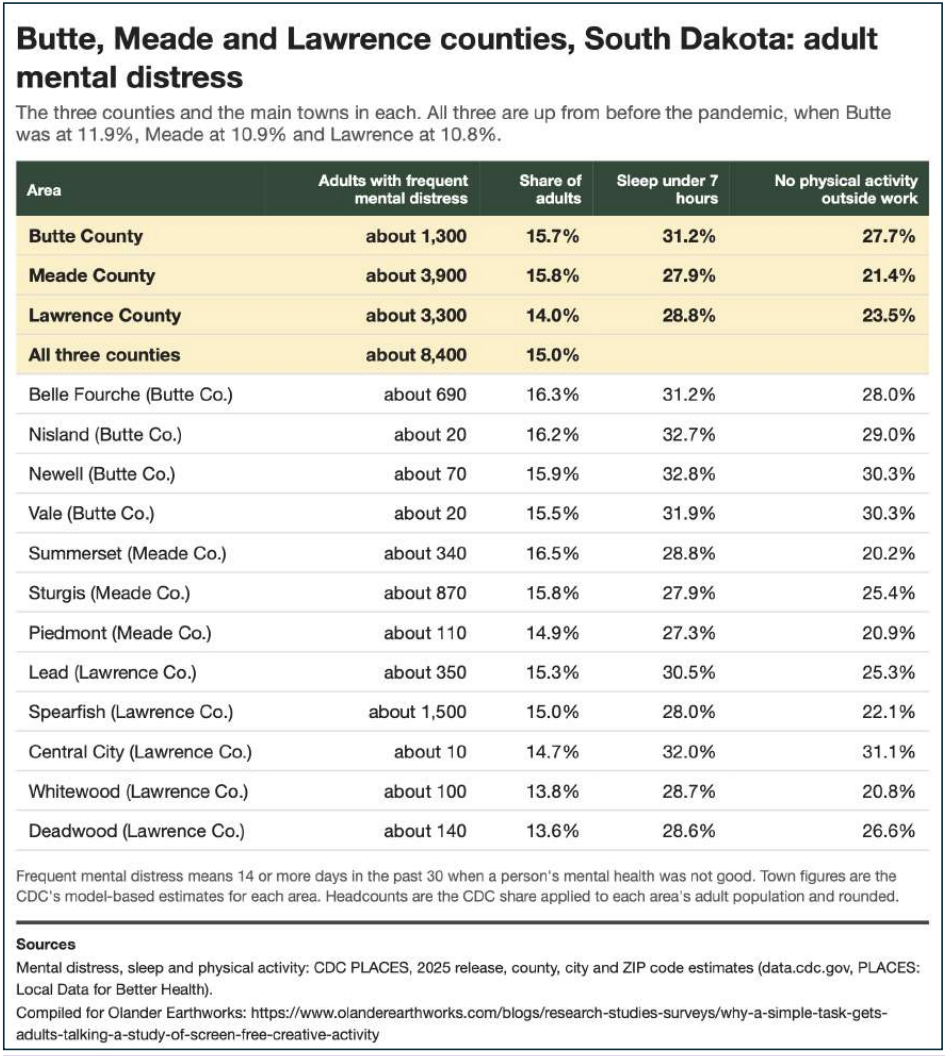
About 8,400 adults across Butte, Meade and Lawrence counties say their mental health was not good on at least 14 of the past 30 days, according to the newest county estimates from the Centers for Disease Control and Prevention. That’s 15.0% of the three counties’ adults.
Meade County is at 15.8%, about 3,900 adults, Butte County is at 15.7%, about 1,300, and Lawrence County is at 14.0%, about 3,300.
All three are well above where they were before the pandemic, when the CDC put Butte County at 11.9%, Meade County at 10.9% and Lawrence County at 10.8%. Every county in South Dakota is higher now.
In Belle Fourche, the rate is 16.3%, about 690 adults. It’s 15.8% in Sturgis, 15.3% in Lead, 15.0% in Spearfish and 13.6% in Deadwood.
The CDC calls this frequent mental distress. It isn’t a diagnosis. It describes people who have spent half the month or more dealing with stress, worry or low mood, most of them still going to work, paying the bills and looking after their families. The numbers come from residents’ own answers to the CDC’s national health survey, modeled down to the county and town level.
The same CDC data shows 31.2% of Butte County adults sleep less than seven hours a night and 27.7% get no physical activity outside of work, two of the habits that tend to slip first when someone is struggling. About one in five Butte County adults, 21.3%, have been told by a doctor or other health professional that they have depression.
Help can be harder to find in Butte County, which has one mental health provider for every 1,361 residents, against one for every 384 across South Dakota, according to County Health Rankings & Roadmaps.
Olander Earthworks, a Portland, Oregon, company that makes screen-free products and researches how adults handle stress, surveyed 121 mental health and allied practitioners about what helps.
Of those, 82% said adults have fewer chances than they used to for unstructured, screenfree activity, and 69% of those who use hands-on activities with clients said people talk more openly once they get going. As one practitioner put it, “Having something to do with their hands made it easier to talk.” The survey is small, so it reflects those practitioners, not the whole field. The full study is at https://www. olanderearthworks.com/blogs/ research-studies-surveys/why-asimple-task-gets-adults-talkinga-study-of-screen-free-creative-activity.
In the Northern Hills, that can look like a walk along the Belle Fourche River or the Mickelson Trail, a class at a community center or a standing coffee with a friend. It won’t replace professional care, but it can help people start talking.
Anyone in crisis can call or text 988, the Suicide and Crisis Lifeline, at any time.
See more pictures and read the full issue of the Belle Fourche Beacon by clicking here.